Scarce and extremely desirable handwritten check, 7.75 x 2.75, filled out, “West Point, N. Y., Cash—Bank of the Old Dominion at Alexandria,” and signed by Lee, “R. E. Lee,” payable to “Cash—B—Farmers Bank of Virginia” for $32.50, July 5, 1854. Several vertical folds, uniform toning, some light areas of soiling (a heavier area showing through from a stain on the reverse), wrinkling to the paper over which the signature is placed, a small area of glue residue, and the expected cancellation cut and red pencil notation, otherwise very good condition.
http://rrauction.com/bidtracker_detail.cfm?IN=434
Showing posts with label Bob Eaton Autographs. Show all posts
Friday, April 6, 2012
Friday, March 23, 2012
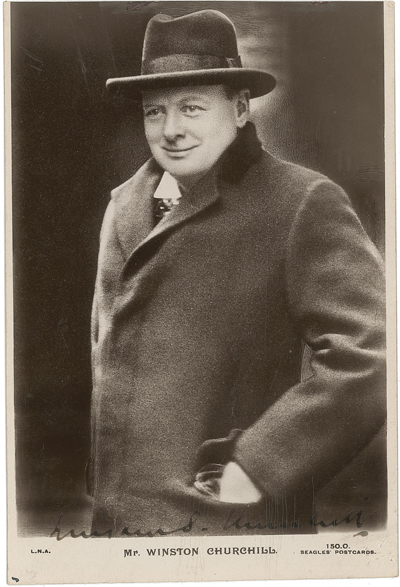
RR Autograph Auctions Winston Churchill Early Parliament
Vintage glossy 3.5 x 5 J. Beagles’ postcard photo of a young Churchill outside in a hat and overcoat, circa 1910, signed along the bottom in fountain pen, “Winston S. Churchill.” In very good condition, with trimmed top edge, paperclip impression along top edge, some light vertical creases, and a bit of light contrast to portion of signature. A particularly early photo of the vibrant man who helped direct and shape the course of history.
http://rrauction.com/PreviewContent.cfm?Winston_Churchill_Signed_photo
Labels:
Bob Eaton Autographs,
Eaton Autographs,
rr auction,
rr auctions,
RR Autograph Auction,
rrauction,
rrauctions,
Winston Churchhill
Monday, March 19, 2012
RR Auctions Jefferson Davis
Partly-printed war-dated DS, signed “Jefferson Davis, Pres’t C. S. A.,” one page, 8 x 10, September 1, 1864. Warrant to the Treasury Department, with portions filled in by Davis, who has also crossed off the printed Department of State letterhead and written “Executive Office.” In full: “Please cause a warrant for the sum of one thousand dollars in gold, payable out of the Appropriation for ‘Secret Service’ (Act of Feb. 18, 1864) to be issued in favor of Hon. J. P. Benjamin, Secretary of State, and charged to him on the books of the Treasury.” In good condition, with paper loss to top left corner and left edge, intersecting folds, one through a single letter of signature, scattered toning, some repaired tears to top edge, a couple other edge tears, mounting remnants to reverse, and a few other cracks to the fragile paper.
During the war, a number of secret operations were mounted with various degrees of official oversight. Many involved acts that were considered by the Union to go beyond the normal conduct of "civilized" warfare, and allegedly included setting fires in New York City hotels (Election Day plot of 1864), poisoning the New York City water supply, infecting Union soldiers and citizens with smallpox and yellow fever, kidnapping President Lincoln and holding him until Confederate soldiers were released, and blowing up the White House. By 1864, the Confederate government was attempting to gain control over these operations. Secret legislation was put before the Confederate Congress that year to create an official Special and Secret Bureau of the War Department, but the legislation was not enacted until 1865 and never implemented. In April of 1865, Confederate Secretary of State Judah P. Benjamin burned most of the official papers of the Secret Service just before the evacuation of Richmond, and the full story of Confederate secret operations was lost. A rare document demonstrating the endorsement of Secret Service activities at the highest level of the Confederacy. Pre-certified John Reznikoff/PSA/DNA and RR Auction COA.
Labels:
Bob Eaton,
Bob Eaton Autographs,
Bob Eaton RR Auction,
Bob Eaton RRauction,
Eaton Autographs,
Jefferson Davis,
R R Autograph Auctions,
RR Autograph Auction
Friday, March 16, 2012
RR Auctions Civil War Bullets
Five Civil War-era bullets, one still housed in its jacket, all framed together to an overall size of 4.75 x 5. In very good overall condition. RRAuction COA.
Labels:
auction,
auctions,
Bob Eaton,
Bob Eaton Autographs,
Bob Eaton RR Auction,
Bob Eaton RRauction,
civil War,
Eaton Autographs,
R R Autograph Auctions,
rr auctions,
RR Autograph Auction,
rrauction,
rrauctions
Thursday, March 15, 2012
RR Auctions John Wilkes Booth
A member of the well-known Booth family of Shakespearean actors and a somewhat erratic, if popular, performer. A supporter of slavery and the South, he participated in the arrest and execution of abolitionist John Brown in 1859. In the fall of 1864, he hatched a plan to kidnap President Abraham Lincoln but the scheme failed. He then concocted the plot to assassinate Lincoln, which he did in Ford’s Theatre on April 14, 1865, before jumping to the stage and allegedly crying out, “Sic semper tyrannis! The South is avenged!” Booth was located and killed twelve days later. War-dated ALS signed “J. Wilkes Booth,” three pages on two adjoining sheets, 5.25 x 8, November 23, 1861. Letter written from Cincinnati to Joseph H. Simonds. In full: “I know you will forgive me, this long delay in answering your letters; if you knew better you would not wonder at it, as I avail myself of any excuse to get rid of writing, no matter how I may long to hear from the person to whom I have to write. And I confess I should like to hear from you every day. I received your photograph, a thousand thanks, I think it very good, I believe you have mine. My second week in Buffalo was so, so. I played 17 nights in Detroit to a good Bus[iness]. After here Monday night, 25th, they count high on me but I am doubtful as to my success. Maggie Mitchel is playing a good engagement here.”
At this point in the letter, Booth’s handwriting begins to get a bit more jumbled. He continues: “I should have has been; as she finished last night. My dear Joe excuse this as I am standing in the office with about a hundred people about me blowing at a fearful rate. I am not fixed yet, so I cannot go to my room. Yours of the 16th also reached me, in Detroit. It seems that Forrest is always in trouble. I am sorry his bus. is not better, for it is rough to see such trash (as Barney Williams practices on the stage), get the best of the legitimate, but such is life. Give my kindest regards to the Bugbee's. Has Mr. B. gone to Cal. yet? I addressed a letter to him in your care, did you get it. I will write to you more intelligibly the next time, so asking you to excuse this again.” Mild toning along two horizontal mailing folds, and a couple light brushes to text, otherwise fine condition. Accompanied by the original mailing envelope, addressed in Booth’s hand and docketed by Simonds.
Published in Right or Wrong, God Judge Me: The Writings of John Wilkes Booth, ed. J. Rhodehamel and L. Taper, pp.93-94. Provenance: The Sang Collection (sale, Sotheby Parke Bernet, 26 April 1978), lot 46 [envelope then present] -- Anonymous owner (sale, Christie's, 9 December 1993, lot 158, $42,550).
This rare long letter, written while standing in a hotel lobby waiting for a room, gives unusual insight into the famed actor's touring stage life. Written to theater buff and close friend, J. H. Simonds, an ambitious Boston Bank clerk with whom Booth had interests in the Pennsylvania oil fields. The mentioned “Forrest” was the famous classical actor Edwin Forrest; his career was plagued by scandals, he had disappeared from the stage after a messy 1850s divorce, and was attempting a 1860-61 comeback. “Maggie Mitchel” was rising star Maggie Mitchell, Lincoln's favorite actresses, who frequently acted with Booth, while “Barney Williams” was a popular Irish-born comic actor who delighted audiences as a blackface minstrel, often playing for the Union troops. “The Bugbee's” mentioned near the letter’s closing were a Philadelphia family, known to the Booths, that moved to Boston before settling in California; John Stevenson Bugbee was living in California at this time.
Booth opened a 10-day engagement on November 25 at Wood's Theatre in Cincinnati, appearing in, among others, Othello, Macbeth, Hamlet, and The Marble Heart (which Lincoln once saw featuring Booth). Although audiences were unimpressed and the box office disappointing, The Cincinnati Commercial declared that "Mr. Booth has caught some of the fire that animated his great father." As his theatrical income declined during the war, Booth turned to his neglected oil investments for income which Simonds had stepped in to oversee. By 1865, Simonds had loaned the actor money, including a $500 bequest that the future assassin used to buy guns and supplies for the abortive plot to kidnap Lincoln in March 1864 (unbeknown to Simonds). After the president's assassination, Simonds was summoned to testify about Booth's investments during Lincoln conspirators' trial in May 1865. A highly desirable and rare letter written to a friend that Booth later used to forward his aborted kidnap plot. The letter is also noteworthy for its very scarce 3¢ pink of 1861 (Scott 64) stamp used on the mailing envelope. Pre-certified John Reznikoff/PSA/DNA and RR Auction COA.
At this point in the letter, Booth’s handwriting begins to get a bit more jumbled. He continues: “I should have has been; as she finished last night. My dear Joe excuse this as I am standing in the office with about a hundred people about me blowing at a fearful rate. I am not fixed yet, so I cannot go to my room. Yours of the 16th also reached me, in Detroit. It seems that Forrest is always in trouble. I am sorry his bus. is not better, for it is rough to see such trash (as Barney Williams practices on the stage), get the best of the legitimate, but such is life. Give my kindest regards to the Bugbee's. Has Mr. B. gone to Cal. yet? I addressed a letter to him in your care, did you get it. I will write to you more intelligibly the next time, so asking you to excuse this again.” Mild toning along two horizontal mailing folds, and a couple light brushes to text, otherwise fine condition. Accompanied by the original mailing envelope, addressed in Booth’s hand and docketed by Simonds.
Published in Right or Wrong, God Judge Me: The Writings of John Wilkes Booth, ed. J. Rhodehamel and L. Taper, pp.93-94. Provenance: The Sang Collection (sale, Sotheby Parke Bernet, 26 April 1978), lot 46 [envelope then present] -- Anonymous owner (sale, Christie's, 9 December 1993, lot 158, $42,550).
This rare long letter, written while standing in a hotel lobby waiting for a room, gives unusual insight into the famed actor's touring stage life. Written to theater buff and close friend, J. H. Simonds, an ambitious Boston Bank clerk with whom Booth had interests in the Pennsylvania oil fields. The mentioned “Forrest” was the famous classical actor Edwin Forrest; his career was plagued by scandals, he had disappeared from the stage after a messy 1850s divorce, and was attempting a 1860-61 comeback. “Maggie Mitchel” was rising star Maggie Mitchell, Lincoln's favorite actresses, who frequently acted with Booth, while “Barney Williams” was a popular Irish-born comic actor who delighted audiences as a blackface minstrel, often playing for the Union troops. “The Bugbee's” mentioned near the letter’s closing were a Philadelphia family, known to the Booths, that moved to Boston before settling in California; John Stevenson Bugbee was living in California at this time.
Booth opened a 10-day engagement on November 25 at Wood's Theatre in Cincinnati, appearing in, among others, Othello, Macbeth, Hamlet, and The Marble Heart (which Lincoln once saw featuring Booth). Although audiences were unimpressed and the box office disappointing, The Cincinnati Commercial declared that "Mr. Booth has caught some of the fire that animated his great father." As his theatrical income declined during the war, Booth turned to his neglected oil investments for income which Simonds had stepped in to oversee. By 1865, Simonds had loaned the actor money, including a $500 bequest that the future assassin used to buy guns and supplies for the abortive plot to kidnap Lincoln in March 1864 (unbeknown to Simonds). After the president's assassination, Simonds was summoned to testify about Booth's investments during Lincoln conspirators' trial in May 1865. A highly desirable and rare letter written to a friend that Booth later used to forward his aborted kidnap plot. The letter is also noteworthy for its very scarce 3¢ pink of 1861 (Scott 64) stamp used on the mailing envelope. Pre-certified John Reznikoff/PSA/DNA and RR Auction COA.
Labels:
Bob Eaton Autographs,
Bob Eaton RRauction,
Eaton Autographs,
John Wilkes booth,
R R Autograph Auctions,
RR Autograph Auction,
rrauction,
rrauctions
Wednesday, March 14, 2012
RR Auctions Abraham Lincoln’s eyeglasses
In 1937, a locked leather box containing the contents of Lincoln’s pockets the night of his assassination in 1865 was donated by the family to the Library of Congress. Included were two pairs of spectacles and their cases. In 1977, the prescriptions for both pairs were examined by the Chief Optician for the Veteran’s Administration. One pair was corrected to +1.75, the other +2.00. The photographs of Abraham Lincoln referred to below are identified by the numbers assigned to them by Lloyd Ostendorf in Lincoln in Photographs: An Album of Every Known Pose by Charles Hamilton and Lloyd Ostendorf (Norman, Oklahoma: University of Oklahoma Press, 1963). The gold colored pair here offered appear to be the spectacles Lincoln is holding in his hands in a photograph made by Alexander Gardner in Washington, D.C., between early February and April 10, 1865 (O-116D), one of a multi-image stereographic pose of four images. Charles Hamilton writes, ‘The President holds his spectacles and a pencil, both blurred, showing that he moved his fingers nervously during the exposure...When the camera failed to record some fascinating or intimate detail, the photographer often employed an artist to retouch or add to the scene. Here Lincoln’s spectacles and pencil, blurred in the original negative, are plainly outlined’ –undoubtedly using the spectacles worn by Lincoln as a model. Numerous books, including Mellon’s The Face of Lincoln reproduce this photograph clearly showing him holding his spectacles . The shape of the lenses of the gold colored pair are identical to those in the photograph (O-116D). The hinge connecting the lens to the temple which loops around the ear has a visible split in the photograph and in the gold colored spectacles. The thin wire temple loop of the gold colored spectacles are clearly visible in the photograph. The catalogue description of these spectacles stated that the gold colored pair (identified in the catalogue as “brass”) had ‘a prescription for +2.75’ and because this strength far exceed the strongest pair found in Lincoln’s pocket (+2.00), this pair could not have been worn by Lincoln. Because of the extraordinary similarity of the spectacles in Lincoln’s hands and the gold colored pair purchased by University Archives, these spectacles were brought to Frank Gyure, American Board of Opticianry Certified and Fellow, National Association of Opticians, who carefully inspected them. The result of his examination is present. In part, ‘The lenses were inspected by a device known simultaneously as a lensometer, focimeter, lensmeter. This device is used to measure the dioptric power of spectacle lenses. The dioptre is the most common unit of measurement of optical power. The device which was used to inspect the presented spectacles was made by the Marco Corporation, a leading manufacturer of optical instruments. It is in good working order to the best of my knowledge ... The spectacle labeled as gold in color had the following Power; +2.12 OD(Right Eye), +2.12 OS(Left Eye)...’ Lincoln had with him two pair of spectacles at the time of his death. One pair was a gift from a lawyer who rode the circuit with Lincoln and was appointed a Washington city marshal by President Lincoln. A temple is inscribed ‘A. Lincoln, presented by Ward H. Lamon.’ This pair was corrected to +2.00. The spectacles here offered is +2.12. It is reasonable to assume that these were not his only spectacles and that the President had others at the Executive Mansion. Ostensibly, Lincoln used different spectacles to read newspapers, books, and letters, so he carried with him more than one pair. Spectacles manufactured in the 19th century varied widely in workmanship, materials and design. In many cases, prescriptions were not made to order, such as the pair Lamon bought. Spectacles were sold by traveling peddlers, at the jewelry shops (where Lincoln bought his first pair), or in general stores. President Lincoln is wearing his spectacles in the famous photograph of Lincoln and his son Tad looking through a photograph album (O-93). It was taken by Anthony Berger at Mathew Brady’s Washington gallery on February 9, 1864. This is the only known close-up photograph of Lincoln wearing spectacles. On November 19, 2008, at Heritage Auctions, a pair of spectacles belonging to Abraham Lincoln sold for $179,250. Accompanying the spectacles were a letter from Mary Harlan Lincoln (Mrs. Robert Todd Lincoln) to Joseph Leisenring presenting him with a book owned by her late son, Abraham Lincoln II, saying, ‘You can put it away with the ‘A.L.’ spectacles which I gave you a long time ago & so have a little memento of the grand-son as well as the grand-father’ and a 1985 affidavit signed by David Rowland, Leisenring’s great-great grandson, setting out the chain of family ownership until their acquisition by Dr. Joseph Lattimer, the consignor of the spectacles. The strength of the lenses of these spectacles was not mentioned in the description suggesting the power was never determined. Those spectacles, as were the gold colored spectacles here offered, originated from Mrs. Robert Todd Lincoln. With President Lincoln’s daughter-in-law being the source of both pairs, the major difference between the Lattimer spectacles and these gold colored spectacles is that all evidence points to these gold colored spectacles being the ones President Lincoln is holding in the photograph taken in early 1865 by Alexander Gardner in Washington, D.C. (O-116D). RRAuction COA.
http://rrauction.com/bidtracker_detail.cfm?IN=1582
Labels:
Abraham Lincoln,
Bob Eaton,
Bob Eaton Autographs,
Bob Eaton RR Auction,
Bob Eaton RRauction,
Eaton,
Eaton Autographs,
R R Autograph Auctions,
rr auctions,
RR Autograph Auction,
rrauction,
rrauctions
Tuesday, March 13, 2012
RR Auctions Manuel de Falla
A quote from his 1926 Harpsicord concertoDescription
Important Spanish composer (1876–1946) who takes a place among the most distinguished figures in twentieth-century music. His ballets The Three-Cornered Hat (1917) and El Amor Brujo (1915) remain staples of the repertory, as do a number of his colorful orchestral and keyboard works. AMQS on the reverse of one of de Falla’s calling cards, 3.25 x 2.25. De Falla pens two bars from his ‘Concerto’ (for Harpsicord), inscribed in Spanish to Donald Sutphin, and signed “M. de Falla 1942.” de Falla also writes a brief Spanish sentiment on the front of the card, which translates to “With my best greetings.” In fine condition, with a couple trivial brushes, some ink flecks to center, and a light crease to top right corner. RRAuction COA.
|
Labels:
Autographs,
Bob Eaton Autographs,
Bob Eaton RR Auction,
Bob Eaton RRauction,
Eaton,
Eaton Autographs,
R R Autograph Auctions,
rr auction,
rr auctions,
RR Autograph Auction,
rrauction,
rrauctions
Monday, March 12, 2012
RR Auctions Walt Disney Crisp and clear personal check
Crisp and clear personal check, 8.25 x 3, filled out in another hand and signed by Disney, “Walter E. Disney,” payable to Walt Disney—Special Account for $1100.00, stamp-dated September 11, 1952. Matted and framed with a beautiful image of Mickey and Minnie to an overall size of 19.25 x 21. Expected cancellation notation, stamps, and holes, the latter of which affect the first three letters of the signature, otherwise fine condition. Pre-certified PSA/DNA and RR Auction COA.
|
Labels:
Bob Eaton,
Bob Eaton Autographs,
Bob Eaton RR Auction,
Bob Eaton RRauction,
Eaton,
Eaton Autographs,
R R Autograph Auctions,
rr auction,
rr auctions,
RR Autograph Auction,
rrauction,
rrauctions,
walt disney
Thursday, March 8, 2012
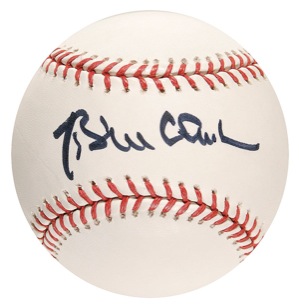
RR Auctions Signed Bill Clinton Baseball
Official Rawlings Major League baseball signed in black felt tip on the sweet spot. In very fine condition. Consignor notes that signature was obtained in June 2008 at Northern State University in Aberdeen, South Dakota, and is accompanied by a photo of the ball and recipient after signing. Pre-certified PSA/DNA and RR Auction COA.
http://rrauction.com/bidtracker_detail.cfm?IN=34
Labels:
Bob Eaton,
Bob Eaton Autographs,
Bob Eaton RR Auction,
Bob Eaton RRauction,
Eaton Autographs,
R R Autograph Auctions,
rr auction,
rr auctions,
RR Autograph Auction,
rrauction,
rrauctions
Tuesday, March 6, 2012
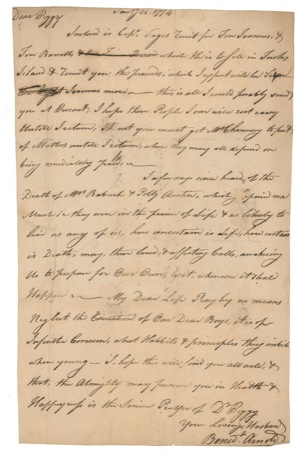
RR Auctions Benedict Arnold
Arnold commiserates to his wife: "How uncertain is Life, how certain
is Death, may, I hear loud & afflicting calls, awakening us to prepare for
Our Own Exit"
ALS signed “Your Loving Husband, Bened’t Arnold,” one page, 8 x
12.75, January 21, 1774. Letter to his wife Margaret Mansfield Arnold. In full:
“Inclosed is Capt. Sages Receit for Ten joammes & Ten barrels which he is to
Sell in the Turks Island & remit you the proceeds which I expect will be
Joammes more, this is all I could probably send you at Present, I hope that
people I owe will not rest easy untill I return. If not, you must get Mr Chauncy
to put off Matters until I return, when they may all depend on being immediately
paid.
So few days since heard of the death of Mr. Babisch & Polly Austin, which surprised me much they were in the prime of their Life & as likely to live as any of us, how uncertain is Life, how certain is Death, may, I hear loud & afflicting calls, awakening us to prepare for Our Own Exit, whenever it shall Happen—My Dear Life Pray by no means Neglect the Education of Our Dear Boys, it is of Infinite Concern what Habbits & principles they imbibe when young—I hope this will find you all well, & that, the Almighty may preserve you in health & Happiness is the Sincere Prayer of Dr. Peggy.” Reverse of letter bears an address panel in an unknown hand. Reverse has also been professionally silked.
Aforementioned silking, intersecting folds, lightly trimmed edges,and several seal-related tears (slightly affecting several words of text) repaired on the reverse, otherwise very good condition. Item comes in its original dealer folder from The American Art Association, stating the letter comes from the Collection of Rev. Dr. Roderick Terry, Catalogue Number 10.
Arnold established a drug and book store in New Haven, Connecticut in 1774, soon expanding his business interests to shipping goods to Canada and the West Indies, including Turks Island, a Bahamian slave trade center. Local businessman Charles Chauncey with whom the merchant conducted business once wrote of Arnold, ‘There are few or new men here that are thought more sufficient at present, as he has had great luck at sea of late.’ The entrepreneur also partnered with friends Adam Babcock and Captain Comfort Sage, wealthy merchants who also traded with the West Indies. In April 1775, Sage and his "Troop of the Light Horse" answered the Lexington alarm while Arnold marched to the Boston Siege. Ironically, the two friends became military opponents when Arnold sold out to the British, but Sage, appointed Brigadier General of the Connecticut militia, hid the traitor's children to protect them from an angry Middletown, Connecticut mob that torched an effigy of Arnold when his treachery was revealed. The once patriot and successful entrepreneur died a penniless, broken and bitter man, "bought by British gold." A highly desirable letter with pre-war association between two men who became Continental Army generals serving General Washington — one who stood by him and one who betrayed him. Pre-certified John Reznikoff/PSA/DNA and RR Auction COA.
So few days since heard of the death of Mr. Babisch & Polly Austin, which surprised me much they were in the prime of their Life & as likely to live as any of us, how uncertain is Life, how certain is Death, may, I hear loud & afflicting calls, awakening us to prepare for Our Own Exit, whenever it shall Happen—My Dear Life Pray by no means Neglect the Education of Our Dear Boys, it is of Infinite Concern what Habbits & principles they imbibe when young—I hope this will find you all well, & that, the Almighty may preserve you in health & Happiness is the Sincere Prayer of Dr. Peggy.” Reverse of letter bears an address panel in an unknown hand. Reverse has also been professionally silked.
Aforementioned silking, intersecting folds, lightly trimmed edges,and several seal-related tears (slightly affecting several words of text) repaired on the reverse, otherwise very good condition. Item comes in its original dealer folder from The American Art Association, stating the letter comes from the Collection of Rev. Dr. Roderick Terry, Catalogue Number 10.
Arnold established a drug and book store in New Haven, Connecticut in 1774, soon expanding his business interests to shipping goods to Canada and the West Indies, including Turks Island, a Bahamian slave trade center. Local businessman Charles Chauncey with whom the merchant conducted business once wrote of Arnold, ‘There are few or new men here that are thought more sufficient at present, as he has had great luck at sea of late.’ The entrepreneur also partnered with friends Adam Babcock and Captain Comfort Sage, wealthy merchants who also traded with the West Indies. In April 1775, Sage and his "Troop of the Light Horse" answered the Lexington alarm while Arnold marched to the Boston Siege. Ironically, the two friends became military opponents when Arnold sold out to the British, but Sage, appointed Brigadier General of the Connecticut militia, hid the traitor's children to protect them from an angry Middletown, Connecticut mob that torched an effigy of Arnold when his treachery was revealed. The once patriot and successful entrepreneur died a penniless, broken and bitter man, "bought by British gold." A highly desirable letter with pre-war association between two men who became Continental Army generals serving General Washington — one who stood by him and one who betrayed him. Pre-certified John Reznikoff/PSA/DNA and RR Auction COA.
Labels:
Benedict Arnold,
Bob Eaton,
Bob Eaton Autographs,
Bob Eaton RR Auction,
Bob Eaton RRauction,
R R Autograph Auctions,
rr auction,
rr auctions,
RR Autograph Auction,
rrauction
Monday, March 5, 2012
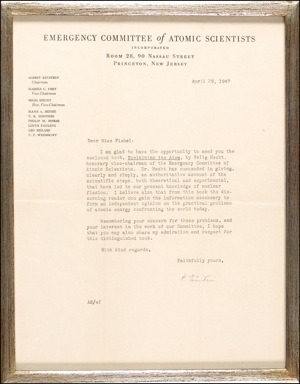
RR Auctions Albert Einstein
“The discerning reader can gain the information necessary to form an
independent opinion on the practical problems of atomic energy”
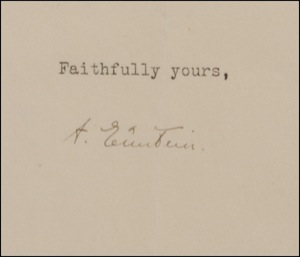
TLS signed “A. Einstein,” one page, 8.5 x 11, Emergency
Committee of Atomic Scientists letterhead, April 29, 1947. Letter to Miss
Fishel. In full: “I am glad to have the opportunity to send you the enclosed
book, Explaining the Atom, by Selig Hecht, honorary vice-chairman of the
Emergency Committee of Atomic Scientists. Dr. Hecht has succeeded in giving,
clearly and simply, an authoritative account of the scientific steps, both
theoretical and experimental, that have lead to our present knowledge of nuclear
fission. I believe also that from this book the discerning reader can gain the
information necessary to form an independent opinion on the practical problems
of atomic energy confronting the world today. Remembering your concern for these
problems, and your interest in the work of our Committee, I hope that you may
also share my admiration and respect for this distinguished book.” Simply framed
to an overall size of 9.25 x 11.75. In fine condition, with intersecting folds,
one through a single letter of signature, and a bit of trivial
soiling.
Einstein personally established the Emergency Committee of Atomic Scientists to warn the public of the dangers associated with the development of nuclear weapons, promote the peaceful use of nuclear energy, and ultimately work towards world peace. Among the committee members was Hecht, who wrote the “authoritative account of the scientific steps, both theoretical and experimental, that have lead to our present knowledge of nuclear fission” that Einstein here states he was sending. At the time, the book had only recently been published and offered the reader a clear explanation of the atom—unique in that Hecht was the only member of the esteemed committee who was not a nuclear physicist, but rather a biophysicist. The work is still regarded as being unsurpassed as an exposition of the history and the theory of the atom. Einstein clearly admired his colleague and his contributions to help encourage and further the peaceful uses of atomic energy. Pre-certified John Reznikoff/PSA/DNA and RR Auction COA.
Labels:
auction,
auctions,
Bob Eaton,
Bob Eaton Autographs,
Bob Eaton RR Auction,
Bob Eaton RRauction,
R R Autograph Auctions,
rr auctions,
RR Autograph Auction,
rrauction,
rrauctions
Subscribe to:
Posts (Atom)