Showing posts with label Eaton. Show all posts

Wednesday, March 14, 2012

RR Auctions Abraham Lincoln’s eyeglasses


Present is a photocopy of an Affidavit and Deed of Gift signed in full and dated 16 August 1977 by Abraham Lincoln’s great grandson and last direct descendant, Robert Todd Lincoln Beckwith (1904-1985): In full, “I, Robert Todd Lincoln Beckwith of Washington, D.C., certify that among the contents of a trunk located and unopened until recently, and placed in the attic of Hildene, the estate of my grandfather Robert Todd Lincoln, Manchester, Vermont, by my grandmother Mary Harlan Lincoln (Mrs. Robert Todd Lincoln), and the said contents being awarded to me by the Estate of my sister Mary Lincoln Beckwith, were found two pair of eye glasses which had belonged to my great grandfather President Abraham Lincoln, and so marked by my grandmother Mary Harlan Lincoln. I further give one pair of these eye glasses to Margaret Fristoe of Chevy Chase, Maryland, and one pair to James T. Hickey of Elkhart, Illinois.” At the time, Hickey was the Curator of the Lincoln Collection of the Illinois State Historical Library, now the Abraham Lincoln Presidential Library. The pair given to Hickey is in the Library’s collection. Abraham Lincoln’s son, Robert Todd Lincoln, married Mary Harlan. Their daughter Jessie Lincoln married Warren Wallace Beckwith. Jessie and Warren’s son, Robert Todd Lincoln Beckwith, married Mrs. Margaret Fristoe (1921-2009) in 1979. Her sole heir was her daughter, Lenora Fristoe Hoverson, Robert Beckwith’s stepdaughter. Her affidavit is also present. Two pair of eyeglasses, both in the trunk at Hildene, among other artifacts, were consigned by Mrs. Hoverson to a reputable mid-west entity and were purchased by University Archives.

In 1937, a locked leather box containing the contents of Lincoln’s pockets the night of his assassination in 1865 was donated by the family to the Library of Congress. Included were two pairs of spectacles and their cases. In 1977, the prescriptions for both pairs were examined by the Chief Optician for the Veteran’s Administration. One pair was corrected to +1.75, the other +2.00. The photographs of Abraham Lincoln referred to below are identified by the numbers assigned to them by Lloyd Ostendorf in Lincoln in Photographs: An Album of Every Known Pose by Charles Hamilton and Lloyd Ostendorf (Norman, Oklahoma: University of Oklahoma Press, 1963). The gold colored pair here offered appear to be the spectacles Lincoln is holding in his hands in a photograph made by Alexander Gardner in Washington, D.C., between early February and April 10, 1865 (O-116D), one of a multi-image stereographic pose of four images. Charles Hamilton writes, ‘The President holds his spectacles and a pencil, both blurred, showing that he moved his fingers nervously during the exposure...When the camera failed to record some fascinating or intimate detail, the photographer often employed an artist to retouch or add to the scene. Here Lincoln’s spectacles and pencil, blurred in the original negative, are plainly outlined’ –undoubtedly using the spectacles worn by Lincoln as a model. Numerous books, including Mellon’s The Face of Lincoln reproduce this photograph clearly showing him holding his spectacles . The shape of the lenses of the gold colored pair are identical to those in the photograph (O-116D). The hinge connecting the lens to the temple which loops around the ear has a visible split in the photograph and in the gold colored spectacles. The thin wire temple loop of the gold colored spectacles are clearly visible in the photograph. The catalogue description of these spectacles stated that the gold colored pair (identified in the catalogue as “brass”) had ‘a prescription for +2.75’ and because this strength far exceed the strongest pair found in Lincoln’s pocket (+2.00), this pair could not have been worn by Lincoln. Because of the extraordinary similarity of the spectacles in Lincoln’s hands and the gold colored pair purchased by University Archives, these spectacles were brought to Frank Gyure, American Board of Opticianry Certified and Fellow, National Association of Opticians, who carefully inspected them. The result of his examination is present. In part, ‘The lenses were inspected by a device known simultaneously as a lensometer, focimeter, lensmeter. This device is used to measure the dioptric power of spectacle lenses. The dioptre is the most common unit of measurement of optical power. The device which was used to inspect the presented spectacles was made by the Marco Corporation, a leading manufacturer of optical instruments. It is in good working order to the best of my knowledge ... The spectacle labeled as gold in color had the following Power; +2.12 OD(Right Eye), +2.12 OS(Left Eye)...’ Lincoln had with him two pair of spectacles at the time of his death. One pair was a gift from a lawyer who rode the circuit with Lincoln and was appointed a Washington city marshal by President Lincoln. A temple is inscribed ‘A. Lincoln, presented by Ward H. Lamon.’ This pair was corrected to +2.00. The spectacles here offered is +2.12. It is reasonable to assume that these were not his only spectacles and that the President had others at the Executive Mansion. Ostensibly, Lincoln used different spectacles to read newspapers, books, and letters, so he carried with him more than one pair. Spectacles manufactured in the 19th century varied widely in workmanship, materials and design. In many cases, prescriptions were not made to order, such as the pair Lamon bought. Spectacles were sold by traveling peddlers, at the jewelry shops (where Lincoln bought his first pair), or in general stores. President Lincoln is wearing his spectacles in the famous photograph of Lincoln and his son Tad looking through a photograph album (O-93). It was taken by Anthony Berger at Mathew Brady’s Washington gallery on February 9, 1864. This is the only known close-up photograph of Lincoln wearing spectacles. On November 19, 2008, at Heritage Auctions, a pair of spectacles belonging to Abraham Lincoln sold for $179,250. Accompanying the spectacles were a letter from Mary Harlan Lincoln (Mrs. Robert Todd Lincoln) to Joseph Leisenring presenting him with a book owned by her late son, Abraham Lincoln II, saying, ‘You can put it away with the ‘A.L.’ spectacles which I gave you a long time ago & so have a little memento of the grand-son as well as the grand-father’ and a 1985 affidavit signed by David Rowland, Leisenring’s great-great grandson, setting out the chain of family ownership until their acquisition by Dr. Joseph Lattimer, the consignor of the spectacles. The strength of the lenses of these spectacles was not mentioned in the description suggesting the power was never determined. Those spectacles, as were the gold colored spectacles here offered, originated from Mrs. Robert Todd Lincoln. With President Lincoln’s daughter-in-law being the source of both pairs, the major difference between the Lattimer spectacles and these gold colored spectacles is that all evidence points to these gold colored spectacles being the ones President Lincoln is holding in the photograph taken in early 1865 by Alexander Gardner in Washington, D.C. (O-116D). RRAuction COA.  

http://rrauction.com/bidtracker_detail.cfm?IN=1582

Tuesday, March 13, 2012

RR Auctions Manuel de Falla


click to enlarge
click to enlarge

A quote from his 1926 Harpsicord concerto

Description

Important Spanish composer (1876–1946) who takes a place among the most distinguished figures in twentieth-century music. His ballets The Three-Cornered Hat (1917) and El Amor Brujo (1915) remain staples of the repertory, as do a number of his colorful orchestral and keyboard works. AMQS on the reverse of one of de Falla’s calling cards, 3.25 x 2.25. De Falla pens two bars from his ‘Concerto’ (for Harpsicord), inscribed in Spanish to Donald Sutphin, and signed “M. de Falla 1942.” de Falla also writes a brief Spanish sentiment on the front of the card, which translates to “With my best greetings.” In fine condition, with a couple trivial brushes, some ink flecks to center, and a light crease to top right corner. RRAuction COA.

Monday, March 12, 2012

RR Auctions Walt Disney Crisp and clear personal check


click to enlarge
click to enlarge

Crisp and clear personal check, 8.25 x 3, filled out in another hand and signed by Disney, “Walter E. Disney,” payable to Walt Disney—Special Account for $1100.00, stamp-dated September 11, 1952. Matted and framed with a beautiful image of Mickey and Minnie to an overall size of 19.25 x 21. Expected cancellation notation, stamps, and holes, the latter of which affect the first three letters of the signature, otherwise fine condition. Pre-certified PSA/DNA and RR Auction COA.


Friday, March 9, 2012

RR Auctions Marquis de Lafayette


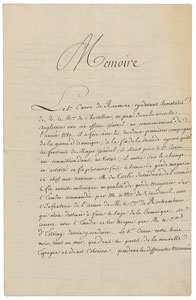
French statesman and military officer (1757–1834) who became an intimate associate of George Washington, and who advanced the American cause on both sides of the Atlantic. Though he espoused many of the principles behind the French Revolution while advocating a limited monarchy, extremist elements in the French Assembly declared him a traitor, whereupon he was jailed for five years. In 1824–1825 he revisited America, where he was hailed as a hero and granted a generous stipend and parcel of land. Handwritten endorsement, in French, signed “Lafayette,” at the conclusion of a manuscript document, three pages on two adjoining sheets, 8 x 12.25, dated July 1, 1790. Document summarizes the military career of Caron de Raumont and solicits a post for him in the Quartermaster Department. Document reads, in part (translated): “Caron, formerly secretary to Minister Chastellux went to New England with that General Officer in 1780. He participated in the first two campaigns of the American War. Chastellux obtained for him a commission in the Supply Corps…he served with the Infantry in the Army of the Count de Rochambeau.” On the last page, Lafayette writes: “I recommend with the greatest intensity this petition to the Administrators; I know of Mr. Caron’s merits and the high regard my intimate friend M. de Chastellux had for him.” Document also bears five other endorsements, including one written and signed by Lafayette’s wife, signed “Noailles Lafayette,” as well as endorsements by Count D’Aure, who writes, in part: “I the undersigned, former Director General of the Quartermaster Corps of the French Army commanded by ther Count de Rochambeau in North America, certify that Mr. Caron was employed in that Army.” The other endorsements are by Chastellux’s widow, the Sieur de Villemaury, Commissioner of War, commended by Rochambeau in his report from Yorktown, and an additional unidentified veteran of the American Revolution. Central horizontal and vertical fold, and some light creasing and toning, otherwise fine condition.

At the outbreak of the Revolutionary War, numerous Frenchmen volunteered for the American cause, including Lafayette. Upon returning to France in 1779, he used his position to lobby for military aid and helped secure 6,000 troops under General Jean-Baptiste de Rochambeau. In the letter, Lafayette attests that Raumont was among these expeditionary forces; he also mentions Major General François-Jean de Chatellux, one of his most outspoken admirers, who was also with Rochambeau’s army. The French troops landed at Newport in 1780, where they remained until Rochambeau and Washington combined forces in 1781, fighting in the Siege of Yorktown and the Battle of the Chesapeake. After uniting with Lafayette’s men, the combined armies forced Lord Cornwallis to surrender at Yorktown in October. A fine document with outstanding Revolutionary War connections.

Pre-certified PSA/DNA and RR Auction COA.


Friday, March 2, 2012

RR Auctions Walt Disney Hollywood Bowl photo


Vintage 6 x 8.5 head-and-shoulders photo from the Hollywood Bowl magazine, signed and inscribed in blue ballpoint, “To The Lovely First Lady of California, Walt Disney.”Scattered light creasing, mild to moderate edge tears, top left and bottom right corner tips missing, and trimmed edges, otherwise very good condition. Accompanied by a photo of Disney and then California governor, Goodwin J. Knight, on stage at the Hollywood Bowl in July of 1955.

This special evening, attended by the governor and his wife, Virginia Knight, was a musical celebration of the phenomena that Walt Disney’s films had already become. A full orchestra was on hand to serenade attendees with the soundtracks that brought some of Disney’s most acclaimed films to life, including including Pinocchio, Lady and the Tramp, and Davy Crockett, which was slated to debut in theatre’s on July 20th. Pre-certified PSA/DNA and RR Auction COA. 

Wednesday, February 29, 2012

RR Auctions Walt Disney Contract


In the contract that made Disneyland a reality, Disney “intends to open to the public a large exhibition park containing educational, scientific and amusement features"


Remarkable DS, twice signed at the conclusion, “Walter E. Disney,” four onionskin pages, 8.5 x 13, March 24, 1954. A “television agreement” between Walt Disney Productions (hereinafter referred to as Productions) and the American Broadcasting Company “for the broadcasting of certain television programs.” The contract goes on to provide a description of the fledgling Disneyland as a “California corporation with an issued and outstanding capital stock of 2500 shares without par value, of which 2400 shares have been issued to Walter E. Disney and 100 shares have been issues to W. E. D. Enterprises,” which “intends to open to the public a large exhibition park containing educational, scientific and amusement features…Productions is entering into an agreement with Disneyland under which Productions will pay to Disneyland a sum equal to 10% of the program basic rate for the filmed television programs, to be furnished by Productions to ABC, as a royalty for the use of the copyrights and format of Disneyland. In addition, Productions will pay Disneyland a sum equal to 5% of such basic rate as a prepaid location charge…If under the television agreement Productions shall receive a price for its filmed television programs in excess of the amount referred to in said agreement, the excess over such minimum price may be paid by ABC delivering to Productions first mortgage bonds of Disneyland at par. The minimum price under the television agreement is $50,000 per program for the first year; $60,000 per program for the second year, and $70,000 per program for the third year.” Also signed at the conclusion by Roy Disney, Lloyd Wright, and the vice president of ABC. In very good condition, with the top left corner of the first page missing, a crease to the bottom left corner of the last page, and the expected document staple marks, creasing, pencil notations, and edge chips.

Disney dreamed about opening a theme park for years, but only secured the necessary capital by collaborating with the television network ABC in 1954. He had created WED Enterprises to undertake the planning and production of the park, but difficulty in raising the necessary funds for the project brought him to look toward television as a revenue source. ABC—the newest and weakest of the television networks—leaped at the opportunity. Leonard Goldenson, ABC’s chairman, was desperate to forge an alliance with Disney for programming. Goldenson championed the deal, and ABC traded a stake in Disneyland the park for the one-hour television series Disneyland. ABC and Walt Disney Productions announced the agreement in a joint press release on April 2, 1954, promising “an entirely new concept in television programming.” Disney would later joke, “ABC needed the television show so damned bad, they bought the amusement park.” Both the show and the park were tremendously successful. An extraordinary document that made Disneyland possible and Disney into a television icon. Pre-certified PSA/DNA and RR Auction COA. 


Saturday, February 11, 2012

RR Auctions Franklin D. Roosevelt Rare oversized signed portrait of FDR’s unprecedented third inauguration


Historic vintage matte-finish 13 x 10 photo of Roosevelt being sworn in as president for the third time on the steps of the US Capitol, signed in fountain pen, as president “Franklin D. Roosevelt.” Also signed “Charles E. Hughes, Jan 20, 1941,” as chief justice, “Cordell Hull,” as Secretary of State “H. A. Wallace,” as Vice President, and “Charles Elmore Cropley, January 20, 1941,” as clerk of the Supreme Court, who held Roosevelt’s family bible as Hughes administered the oath of office. Matted and framed to an overall size of 17.5 x 15. Some light contrast and a bit of irregular ink adhesion to portions of Roosevelt’s signature, a few scattered light creases, and last letter of Wallace’s signature matted out, otherwise fine condition.

After serving eight years in the White House, FDR faced the difficult choice of running for office again, but worldwide events swayed him to run for an unprecedented third term. He must have felt the ominous tides of war after Hughes administered the oath and heard the thunder of guns when Supreme Court clerk Cropley dropped his family's Dutch bible so soon after he had touched it and sworn the oath. In his inauguration speech, he declared, "In this day the task of the people is to save that Nation and its institutions from disruption from without."

Isolationism in America was coming to an end and Roosevelt felt the pressure of unfolding world events as Winston Churchill on the day of his inauguration admonished neutral nations to support the Allied cause and Japan expanded in intelligence budget to $500,000 to spy on the United States. Surely as he delivered his speech, the president knew the threat as he spoke "In the face of great perils never before encountered, our strong purpose is to protect and to perpetuate the integrity of democracy. For this we muster the spirit of America, and the faith of America. We do not retreat. We are not content to stand still. As Americans, we go forward, in the service of our country, by the will of God." On December 7, 1941, the Japanese launched a devastating attack on Pearl Harbor and America finally entered World War II. A remarkable image from an unprecedented and historically-significant event. Pre-certified John Reznikoff/PSA/DNA and RR Auction COA. 

Tuesday, February 7, 2012

RR Auctions first American Patriots Auction


RR Auction is pleased to announce our first American Patriots auction on January 27. This stunning assemblage of letters and relics come straight from the very hands that birthed our nations’ freedom on August 2, 1776, as Hancock, Adams, and Franklin signed the formal copy of the Declaration of Independence. Boasting over 40 of the 56 signers, including three notoriously scarce individuals like George Taylor, Thomas Nelson, Jr., and the most obscure of all, Thomas Lynch, Jr., the American Patriots auction will breathe fresh life into the revolution, once again honoring the congressmen, delegates, generals, and soldiers who laid the foundation for our nation as we know it.

On March 1, 1776, Thomas Lynch, Jr. penned a florid letter on behalf of this father, Thomas Lynch, Sr., a South Carolinian delegate to the First Continental Congress. As a result a cerebral hemorrhage, Lynch’s father was rendered paralyzed; Lynch was forced to take leave of his post in the South Carolina militia, assuming his father’s place as the 52nd declaration signer. Lynch’s overwhelming scarcity was made destiny by an ill-fated sea voyage he and his wife would embark on in 1779, never to be heard from again. His library and estate was scattered, destroyed, and lost, making this unlikely signer the most invaluable, even in comparison to Button Gwinnet; this 1776 handwritten letters represents only one of three known to exist.

Thomas Nelson, Jr., who has been categorized as “very rare” in Kenneth W. Rendell’s, History Comes to Life, provides a lengthy piece of correspondence, brimming with political opinion, penned on February 18, 1775, exactly two months before the British would unleash their fury upon the shores of Massachusetts.

Also falling under Rendell’s “very rare” category is last minute signer, George Taylor.  This war-dated letter, written on the 18th of November, 1780, provides a first-hand look at Taylor’s ironwork business, a trade that won him a contract with the Pennsylvania’s Committee of Safety, making him the first ironmaster to provide cannon shot to the Continental Army. This letter is only the second letter known to ever appear in auction, qualifying its insurmountable scarcity.

An exceptionally uncommon letter from Thomas Jefferson to President George Washington dated February 17, 1791, concerning expansion of settlements northwest of the Ohio during the Northwest Indian Wars. Any correspondence between Jefferson and President, especially referencing the very fibers of the nation’s territorial acquisitions, is of the utmost rarity.

Other offerings of paramount rarity include General George Washington’s prized map, outlining the Theater of War northeast of the Delaware River, illustrating the critical victories at Trenton and Princeton from December 26, 1776 through January 3, 1777, remains in remarkably clear condition, as does his September 11, 1799 letter concerning the purchase of materials used for the construction of the nation’s capitol, Federal City. Martha Washington’s uncommon correspondence to her favorite niece, Fannie Bassett, dated October 18, 1794, provides a substantial example of the First Lady’s hand.

And last, but certainly not least, an impeccably-preserved and magnificently scarce set of six silver spoons, crafted by none other than the Midnight Rider himself, have stood the test of time and, after 220 years, remained steadfastly together. One of the most celebrated and sought-after silversmiths of his time, Revere personally crafted this set for the prominent Boston couple, Daniel and Mary Turner Sargent. This original set heralds from the prized collection of noted silversmith and Revere collector, George Gebelein, who first came into possession of the collection in 1938.

This specialized collection, also including an entirely handwritten financial account of New Hampshire delegate, Josiah Bartlett’s, compensation for signing the Declaration; an ironically hopeful letter from John Andre, penned just a month before his execution after being captured as a spy; a riveting letter from Colonel Azor Orne, and many, many more desirable signatures and relics, will be available for bidding January 27. For details, go to http://www.rrauction.com